Spatially Resolved Physical Properties of Young Star Clusters and Star-forming Clumps in the Brightest z > 6 Galaxy, the Strongly Lensed Cosmic Spear at z = 6.2
Published in Accepted for publication in ApJ, 2025
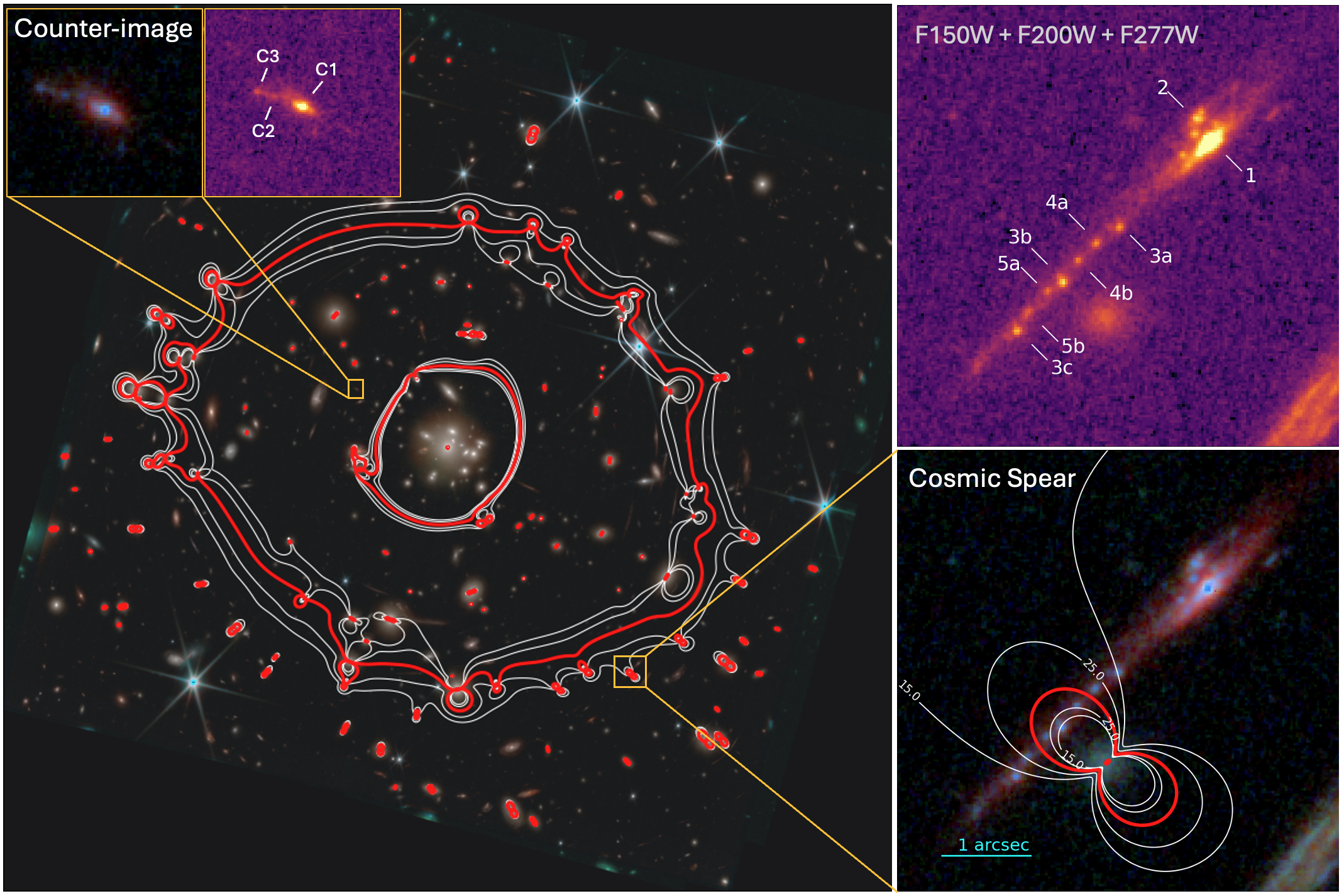
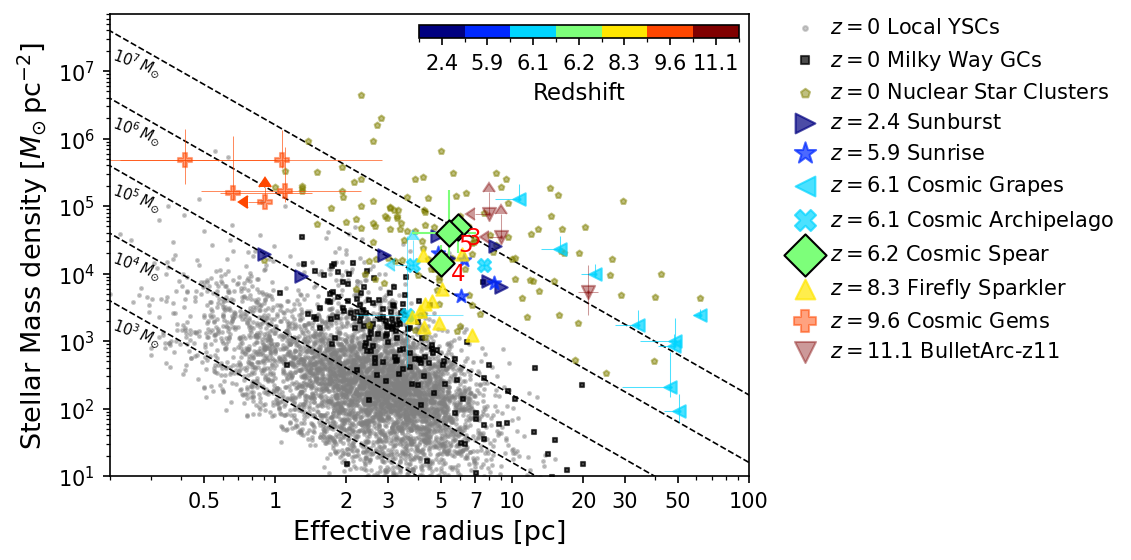
We present a spatially resolved analysis of stellar populations in the brightest z>6 galaxy known to date (AB mag 23), the strongly lensed MACS0308-zD1 (dubbed the ``Cosmic Spear’’) at spec-z=6.2. New JWST NIRCam imaging and high-resolution NIRSpec IFU spectroscopy span the rest-frame ultraviolet to optical. The NIRCam imaging reveals bright star-forming clumps and a tail consisting of three distinct, extremely compact star clusters that are multiply-imaged by gravitational lensing. The star clusters have effective radii of around 5 pc, stellar masses of 10^6-10^7 Msun, and high stellar mass surface densities of > 10^4 Msun/pc^2. While their stellar populations are very young (around 5-9 Myr), their dynamical ages exceed unity, consistent with the clusters being gravitationally bound systems. Placing the star clusters in the size vs.~stellar mass density plane, we find they occupy a region similar to other high-redshift star clusters within galaxies observed recently with JWST, being significantly more massive and denser than local star clusters. Spatially resolved analysis of the brightest clump reveals a compact, intensely star-forming core. The ionizing photon production efficiency ($\xi_{\rm{ion}}$) is slightly suppressed in this central region, potentially indicating a locally elevated Lyman continuum escape fraction facilitated by feedback-driven channels.