GalSyn I: A Forward-Modeling Framework for Synthetic Galaxy Observations from Hydrodynamical Simulations and First Data Release from IllustrisTNG
Published in ApJS, 286, 60, 2026
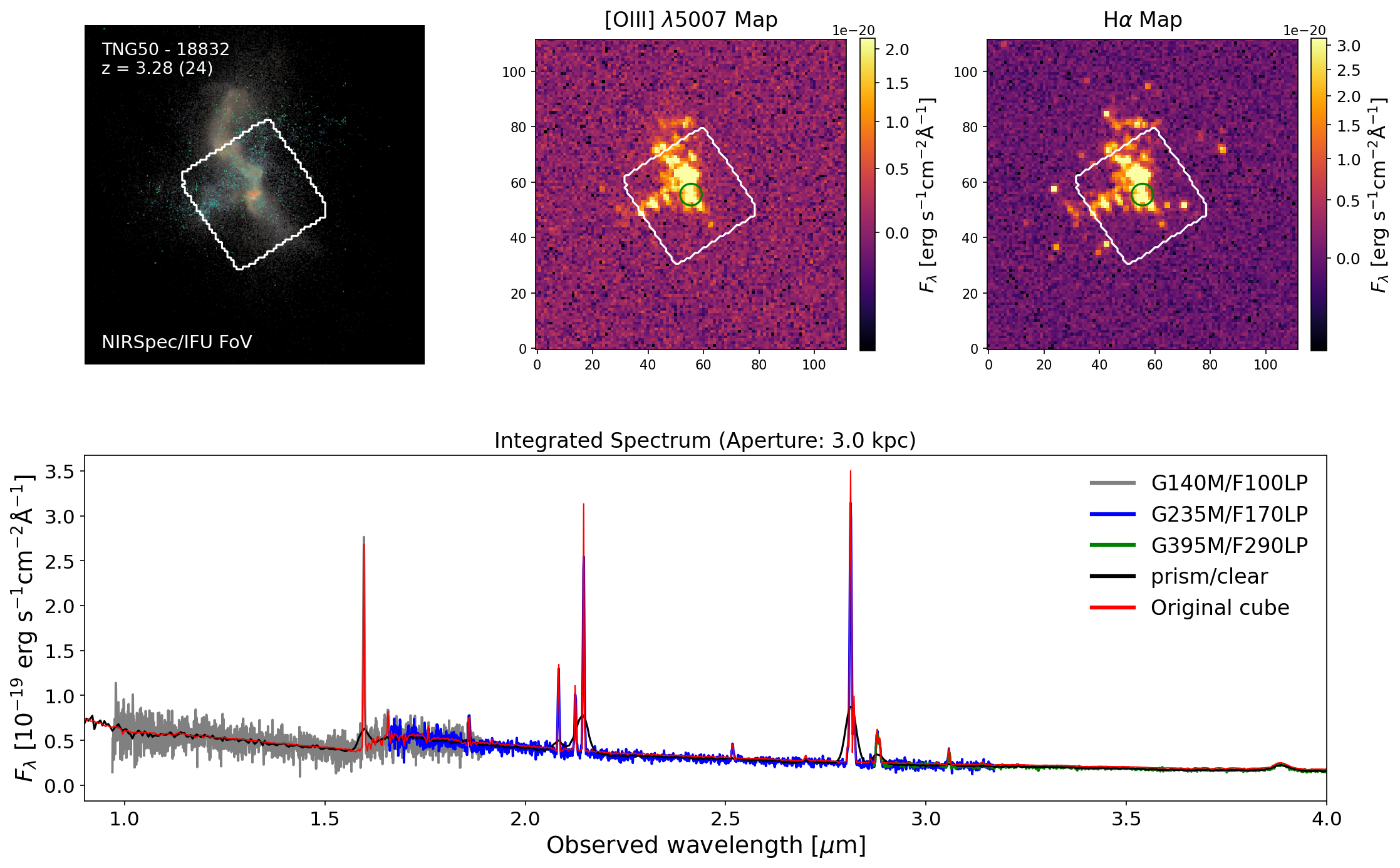
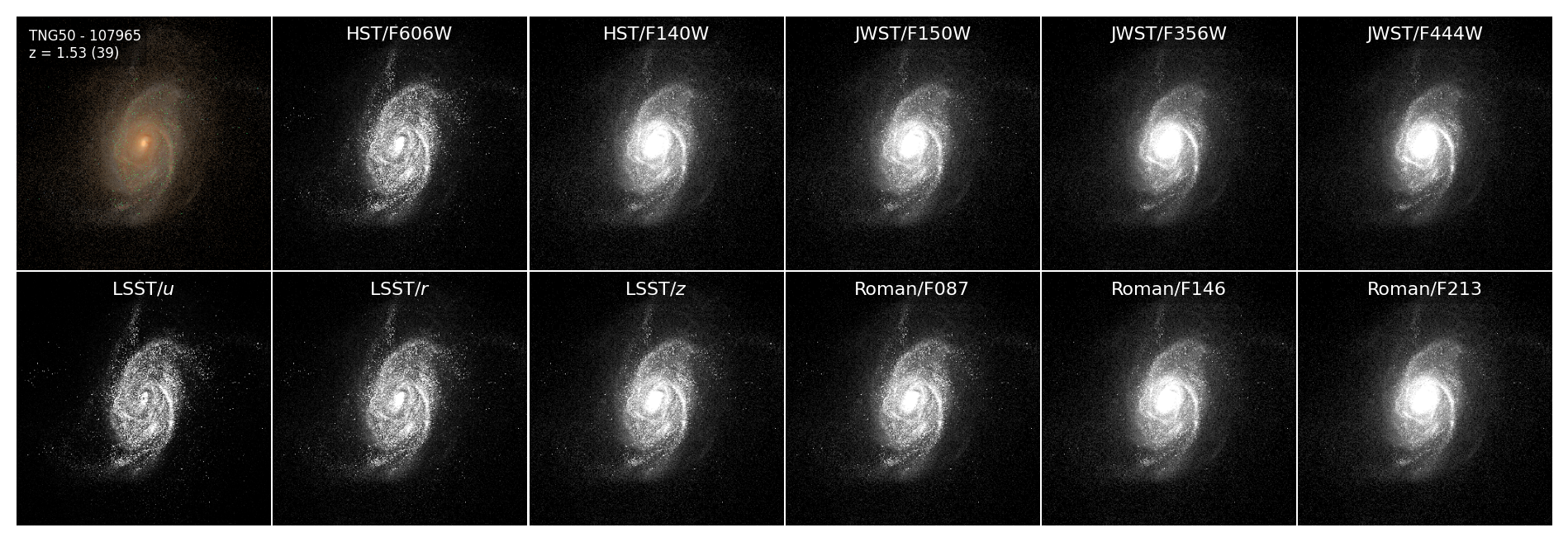
We present GalSyn (Galaxy Synthesizer), a modular and flexible Python package for generating synthetic spectrophotometric observations from hydrodynamical galaxy simulations. GalSyn employs a particle-by-particle spectral modeling approach that enables the rapid production of large synthetic datasets required for statistical population studies, offering a computationally efficient alternative to full radiative transfer codes. Users have full control over the spectral modeling choices, including the choice of stellar population synthesis engine, stellar isochrones, spectral libraries, and initial mass functions. Dust attenuation is modeled at the spatially resolved level via a line-of-sight column density method, with a comprehensive suite of fixed and adaptive attenuation laws. A decoupled kinematics model independently Doppler-shifts the stellar and nebular components, enabling realistic synthetic IFU data cubes. It also provides features to add observational realism, including PSF convolution and multi-component noise simulation. Beyond imaging and spectroscopic data cubes, GalSyn reconstructs spatially resolved physical property maps and star formation histories. Alongside this paper, we present the first public data release of synthetic imaging observations and spatially resolved star formation histories generated from the IllustrisTNG simulation suites, comprising four mock extragalactic survey fields (with areas of 5, 8, 137, 365 arcmin 2), progenitor histories of 290 local massive galaxies (log(M∗,z=0/M⊙)>10.5) tracked across $0<z<5$, and 259 major-merger systems. Each galaxy data cube contains imaging in 47 filters spanning HST, JWST, Euclid, Rubin/LSST, and the Roman Space Telescope. GalSyn is publicly available at https://github.com/aabdurrouf/GalSyn.