The first galaxies
JWST has opened the first billion years of cosmic history. I study the interstellar conditions, chemical enrichment, and internal structure of the earliest galaxies, often magnified by gravitational lensing down to parsec scales.
- When and how did the first galaxies form?
- What were the physical conditions of the interstellar medium during reionization?
- How did star clusters and giant clumps form, and did they survive to become globular clusters today or merge to build bulges?
Probing the ISM at z > 10
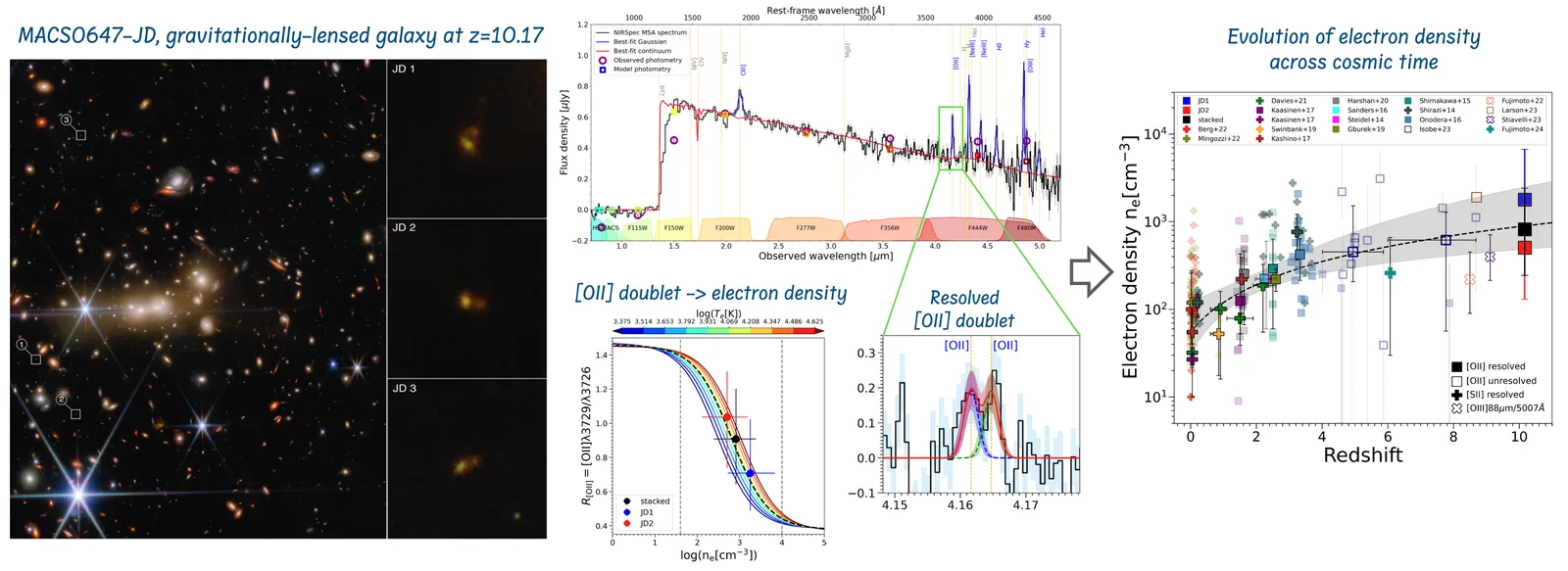
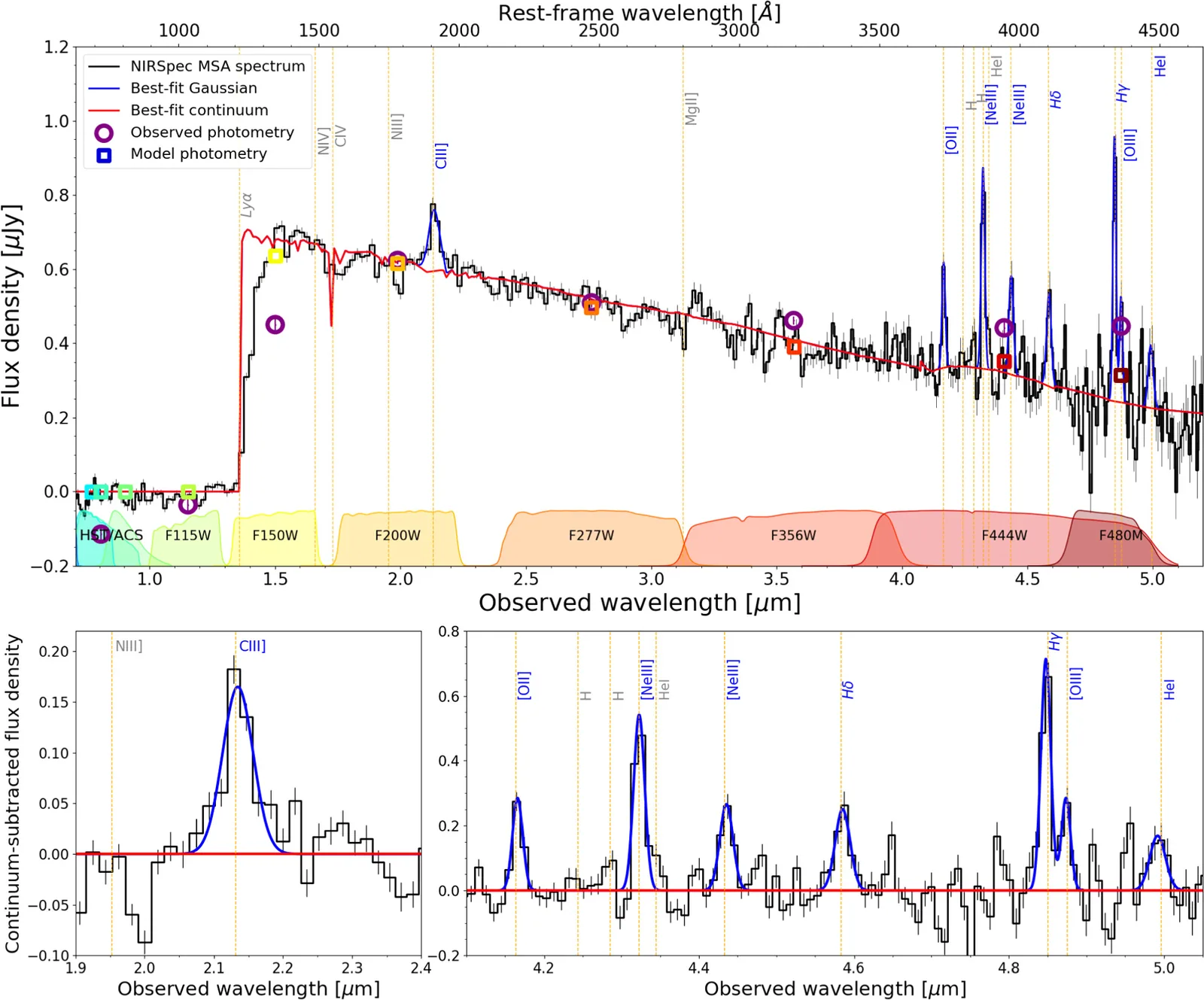
Ground-based surveys and HST revealed galaxies to z ~ 6–8, but the first few hundred million years stayed out of reach until JWST. As part of JWST GO 1433 (PI: Coe), we obtained NIRSpec prism spectroscopy of the triply lensed galaxy MACS0647-JD at z = 10.17 and detected seven rest-UV and optical emission lines, among the earliest such detections (Hsiao, Abdurro’uf et al. 2024).
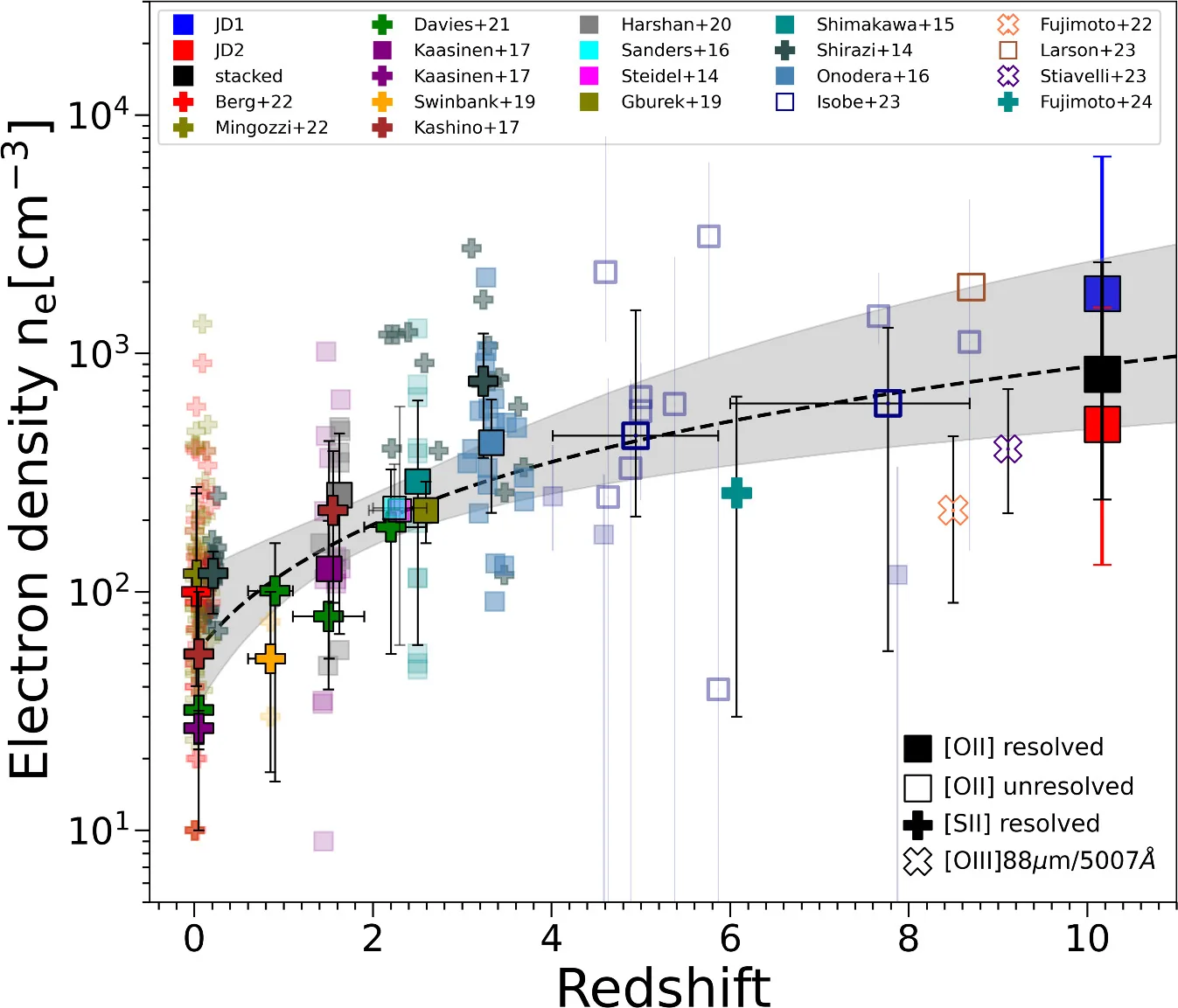
In my own JWST Cycle 2 program GO 4246 (PI), we returned to MACS0647-JD with high-resolution NIRSpec spectroscopy and resolved the [O II] λλ3726,3729 doublet. This gave the first direct measurement of the ISM electron density at z > 10 (Abdurro’uf et al. 2024). The measured density fits a picture in which ISM density rises toward higher redshift, consistent with more compact, actively star-forming early galaxies.
Star clusters and clumps in lensed galaxies
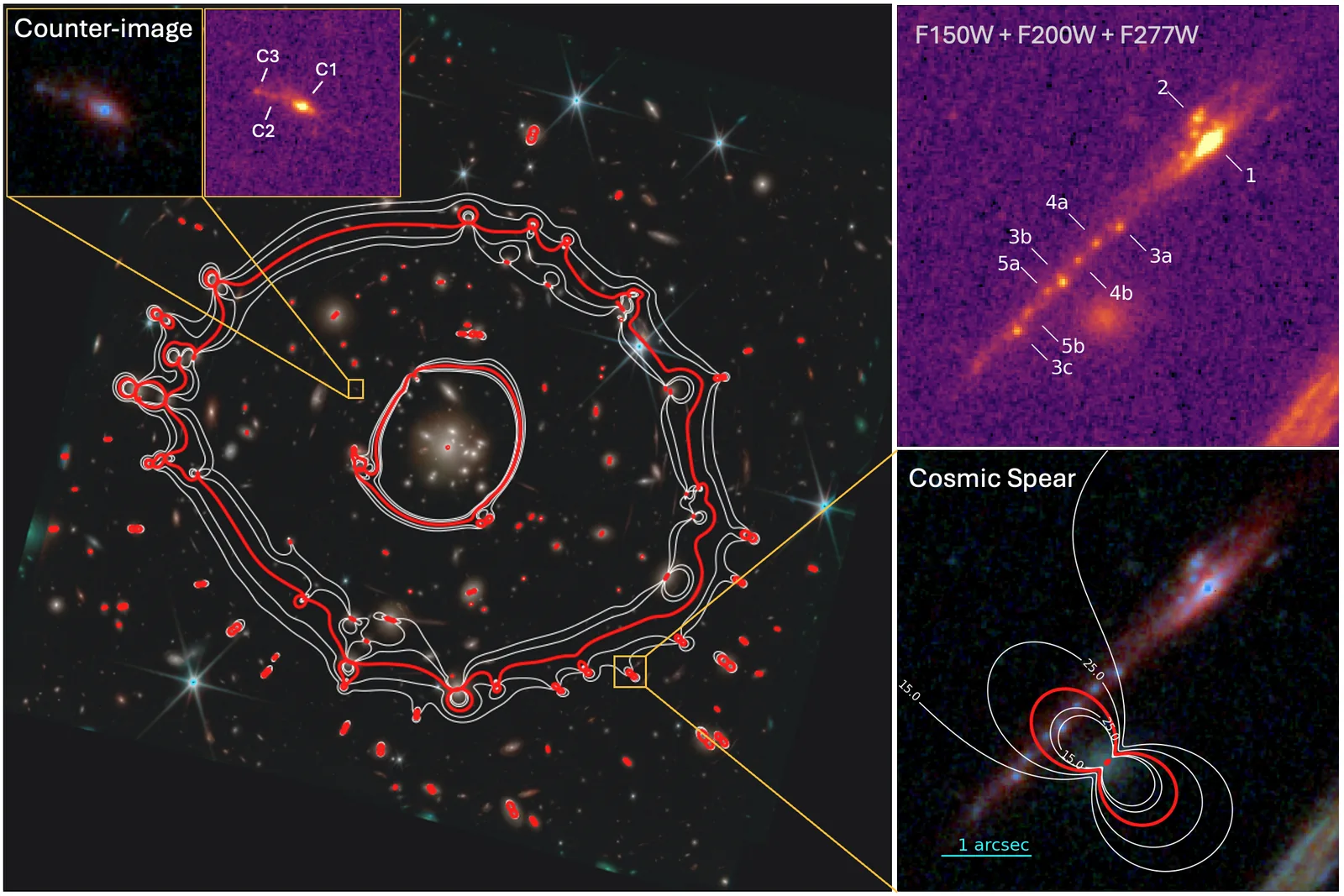
Strong lensing turns galaxy clusters into natural telescopes. In the Cosmic Spear, the brightest known galaxy at z > 6, we resolved young star clusters and star-forming clumps and mapped their stellar populations with spatially resolved SED fitting (Abdurro’uf et al. 2025, ApJ in press). Their ages, masses, and stellar surface densities can be compared directly with star clusters from the local Universe to cosmic dawn. A central goal of this work is to connect the star clusters we find at high redshift with those in the local Universe, especially globular clusters. By comparing their masses, sizes, densities, ages, and metallicities with those of present-day globular clusters, and by following how they are expected to evolve over cosmic time, I aim to test whether the dense clusters seen in the first billion years are the progenitors of the globular clusters we observe today.
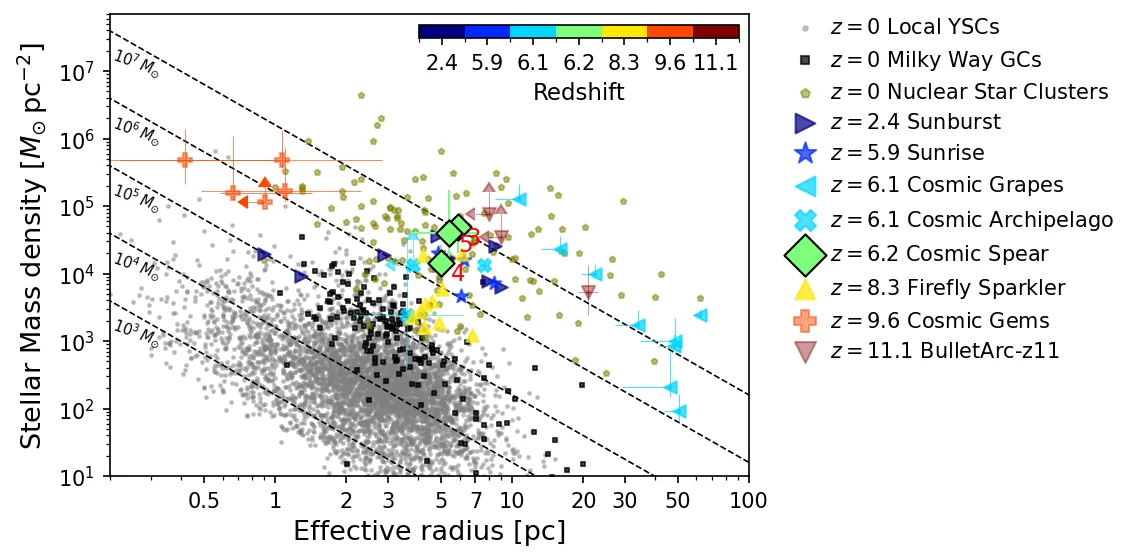
I also work within JWST collaborations on the earliest galaxies, including bound star clusters observed 460 Myr after the Big Bang in the Cosmic Gems arc (Adamo et al. 2024, Nature), strong damped Lyman-α absorption in young star-forming galaxies at z = 9–11 (Heintz et al. 2024, Science), JWST MIRI detections of Hα and [O III] and a direct metallicity measurement of MACS0647-JD at z = 10.17 (Hsiao et al. 2024), and pure-parallel and lensing surveys (BEACON, VENUS, Cosmic Spring).
// what’s next
- Build a statistical sample of lensed clumps and star clusters from VENUS and Cosmic Spring, and compare their ages, masses, metallicities, and radial trends with high-resolution zoom simulations forward-modeled with GalSyn.
- Test whether the first massive quiescent galaxies (z > 3) followed the same compaction-driven fast track as galaxies at cosmic noon, and whether low-mass “mini-quenching” at z > 5 is temporary and burst-driven.
- Use anomaly detection in the latent space of SBI networks to find rare, short-lived phases and target them for JWST follow-up.