From pixels to physics
Traditional spatially resolved SED fitting costs tens of CPU-minutes per galaxy, which is impossible for the 106–107 galaxies Euclid and Roman will resolve. I develop GalSyn-SBI, an amortized simulation-based inference (SBI) code trained on GalSyn mocks, that recovers global and resolved property maps and star-formation histories with calibrated uncertainties, more than 1000× faster.
- Can we infer resolved galaxy properties for millions of galaxies with calibrated uncertainties?
- How biased are standard measurements, for example through outshining by young stars?
- How do we stay robust when real galaxies differ from every simulation?
GalSyn-SBI
From pixels to physics: the package that implements the methods on this page. Raw multiband pixels go in, and calibrated physical-property maps come out. See the software page →
Two networks: global and resolved
Because GalSyn mocks come with known ground truth, I train neural posterior estimators directly on realistic, PSF-convolved, noise-added multiband image cubes. This extends amortized SED inference from integrated photometry to images.
GALSYN_SBI_GLOBAL
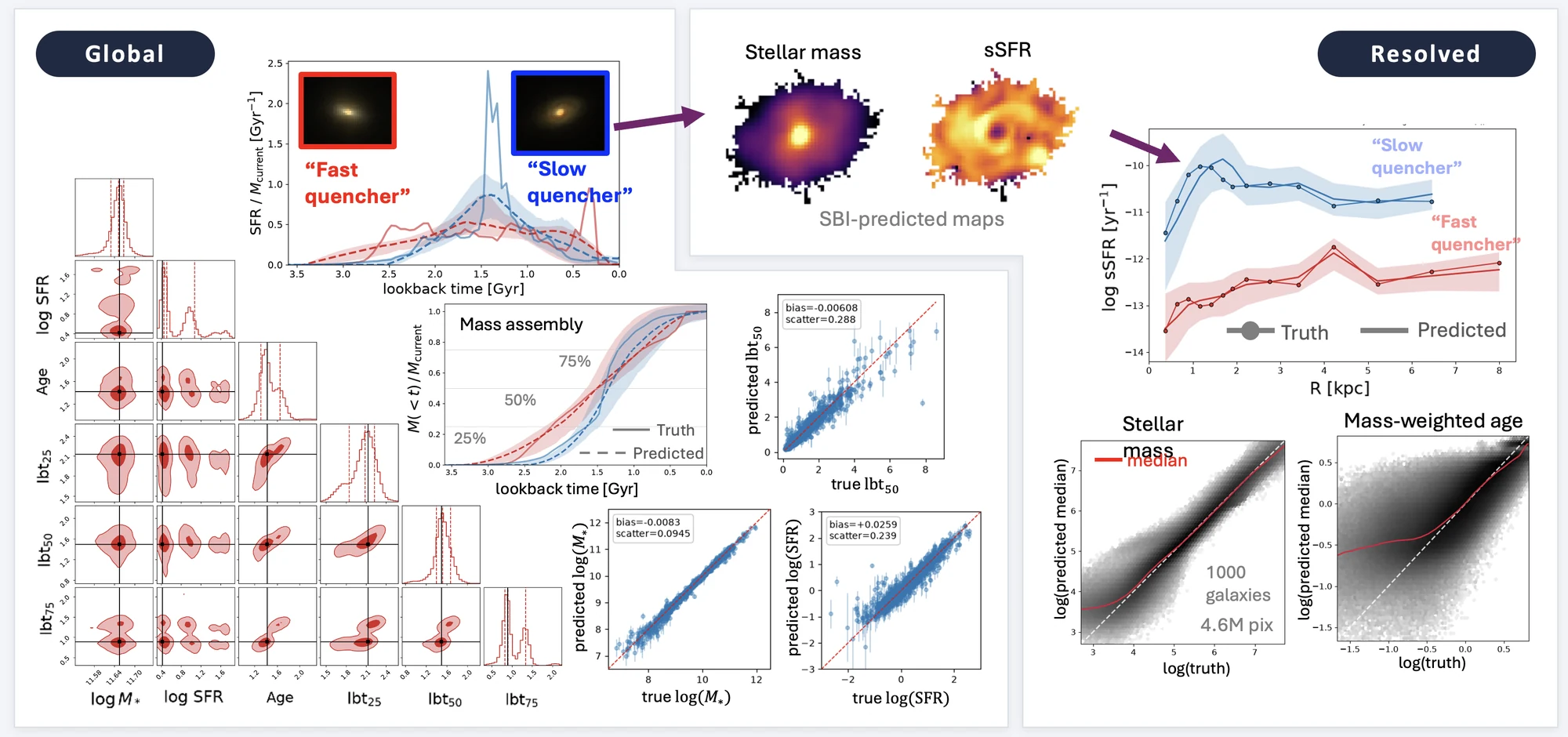
A convolutional network compresses the whole image cube into a summary vector, which conditions a normalizing flow over integrated M*, SFR, Z*, age, AV, and the lookback times at which 25/50/75% of the mass formed. These are used to reconstruct the full star-formation history.
GALSYN_SBI_MAP
A U-Net encoder–decoder produces a feature vector for every pixel that encodes its colors and its surroundings (PSF blending, structure). A shared conditional flow maps each vector to a joint posterior of M*, SFR, age, Z*, AV, and Zgas per pixel.
Preliminary results
Trained on 14,448 TNG50 synthetic cubes, the global model recovers stellar mass with −0.01 dex bias and 0.1 dex scatter, SFR to 0.24 dex, and the half-mass formation time to 0.29 Gyr. Its posterior SFHs separate fast quenchers from slow ones. The map model recovers pixel-level stellar masses over four decades and reproduces radial sSFR profiles.
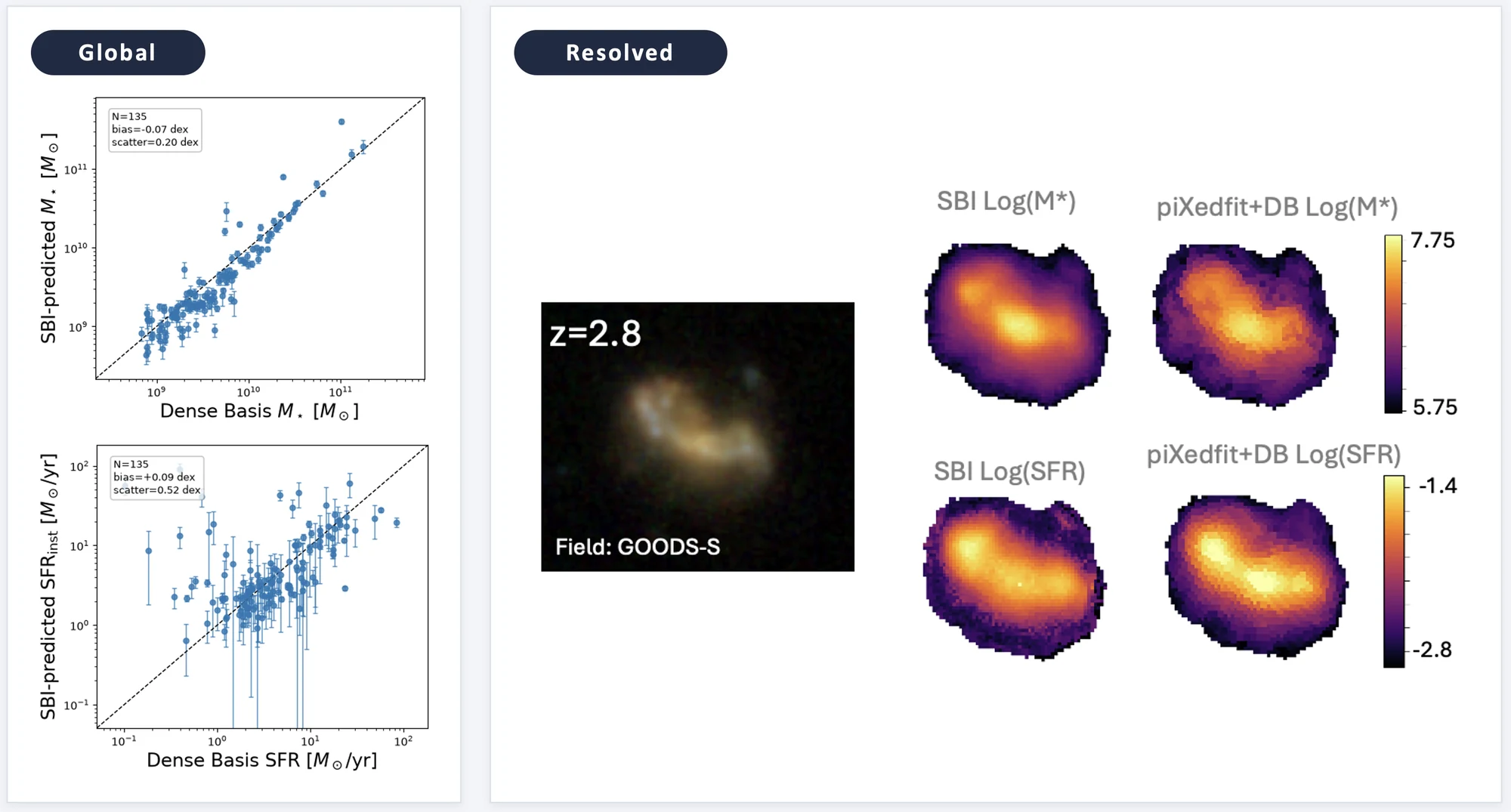
On real data, SBI stellar masses for 135 JADES galaxies agree with traditional fits to −0.07 dex (0.20 dex scatter). SBI maps of a z = 2.8 galaxy reproduce those from piXedfit in under one second instead of more than 30 CPU-minutes.
Trustworthy inference for the survey era
Survey-scale inference raises problems that must be solved before these data can be used:
- Domain shift between simulations and real galaxies: training on multiple simulations, out-of-distribution detection, domain adaptation, and an observed truth set built from the JWST archive.
- Blending: ML segmentation and SED-based deblending trained on GalSyn scenes.
- Photometric-redshift uncertainties and spatially varying PSFs and depths across surveys.
- Model misspecification: how to make inference robust where real galaxies differ from the simulations used for training, and how to detect and quantify such differences.
// what’s next
- Apply SBI to all public JWST/NIRCam deep fields to deliver outshining-corrected stellar masses and SFHs, and public catalogs of resolved maps with pre-trained models.
- Release GalSyn-SBI with calibrated, pre-trained SBI models with standard validation: simulation-based calibration, coverage tests, and OOD flags.
- Test whether embeddings from astronomical foundation models (e.g., AstroCLIP), fine-tuned with SBI heads, improve robustness to domain shift.
- Use anomaly detection in SBI latent space to find rare evolutionary phases.