Forward modeling of simulations
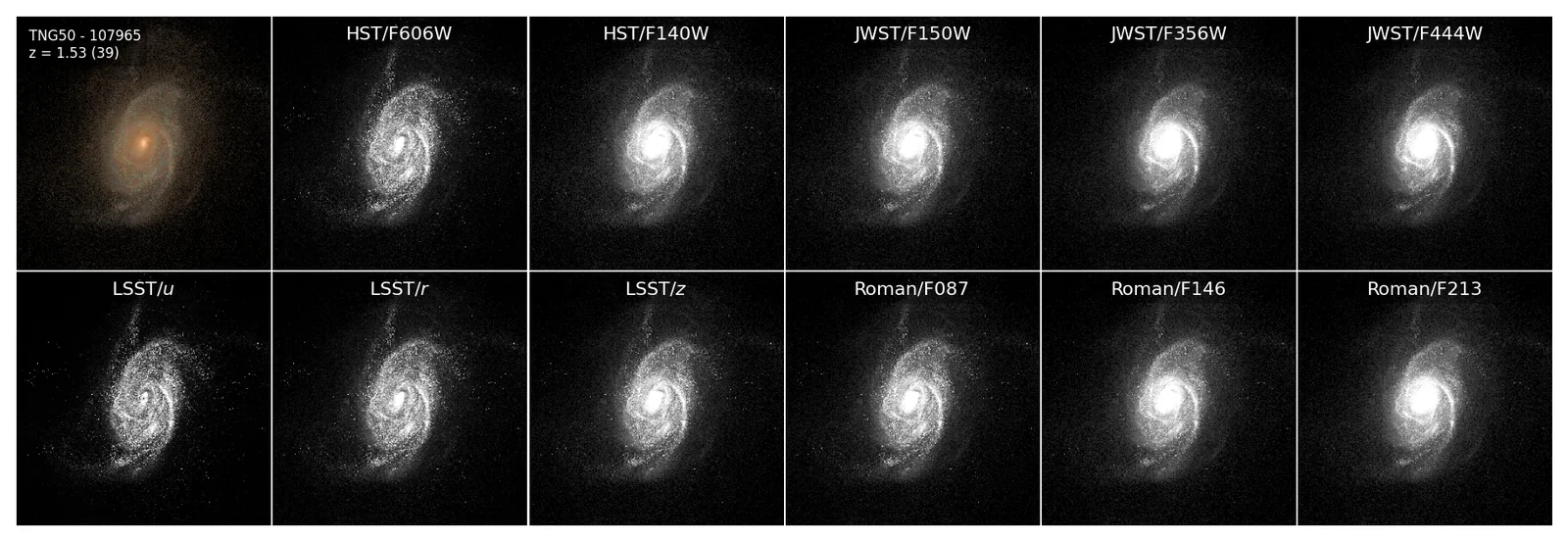
Simulations and observations rarely meet on equal footing: one gives particles, the other gives noisy, PSF-blurred pixels. I build forward models that turn simulated galaxies into realistic telescope data with full ground truth, so that theory can be tested in the observational domain and inference methods can be validated where the answer is known.
- How well can we recover the true properties of galaxies from realistic data?
- Where do simulations and observations agree, and where do they point to missing physics?
- Can resolved observations constrain the sub-grid physics of galaxy formation?
GalSyn: the Galaxy Synthesizer
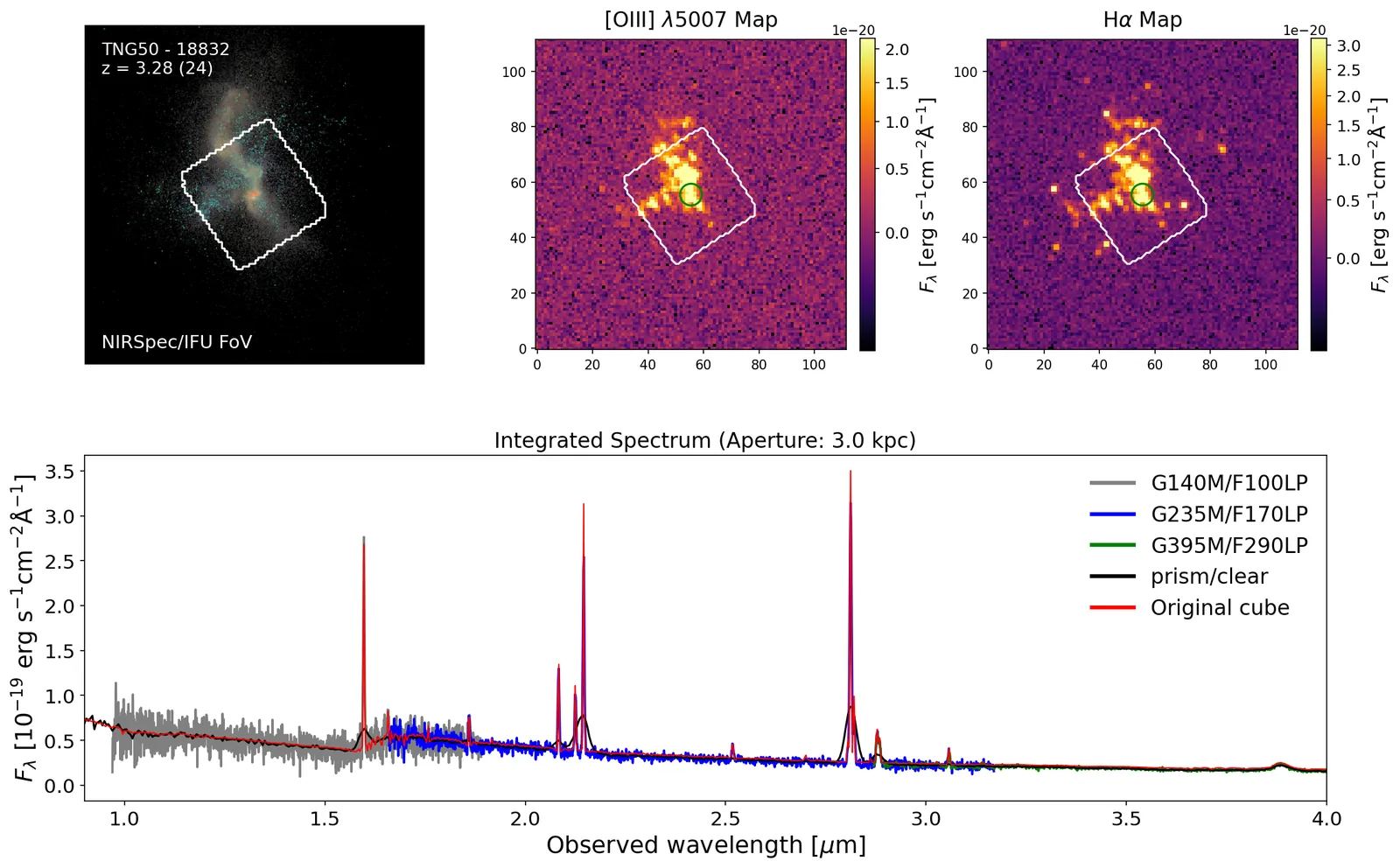
GalSyn is a fast, modular, open-source Python code that turns hydrodynamical simulations into synthetic broadband imaging and integral-field spectroscopy, together with complete ground-truth maps of stellar mass, SFR, age, metallicity, and dust (Abdurro’uf et al. 2026, ApJS 286, 60). Its first data release is built from IllustrisTNG.
Preparing for Euclid
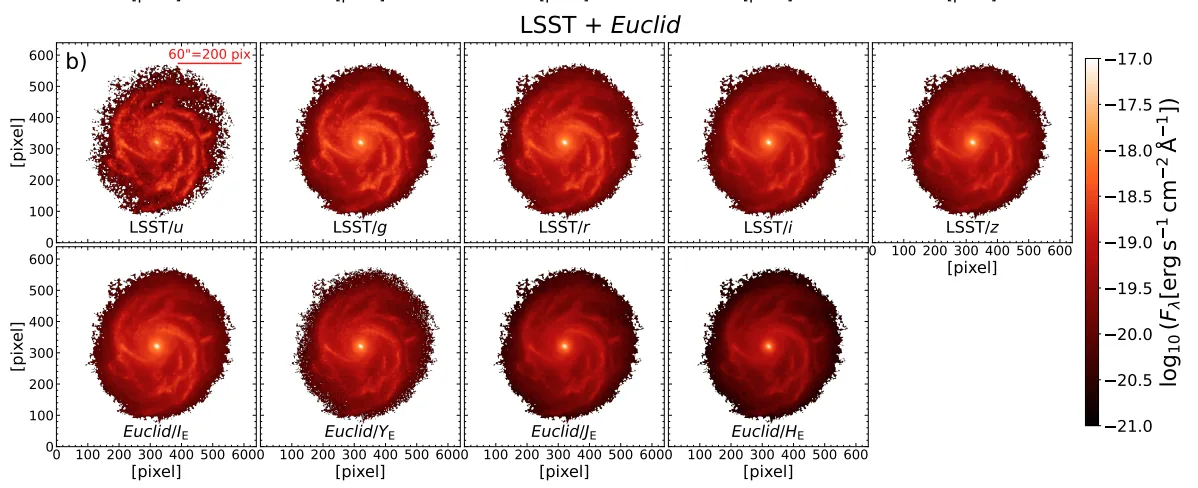
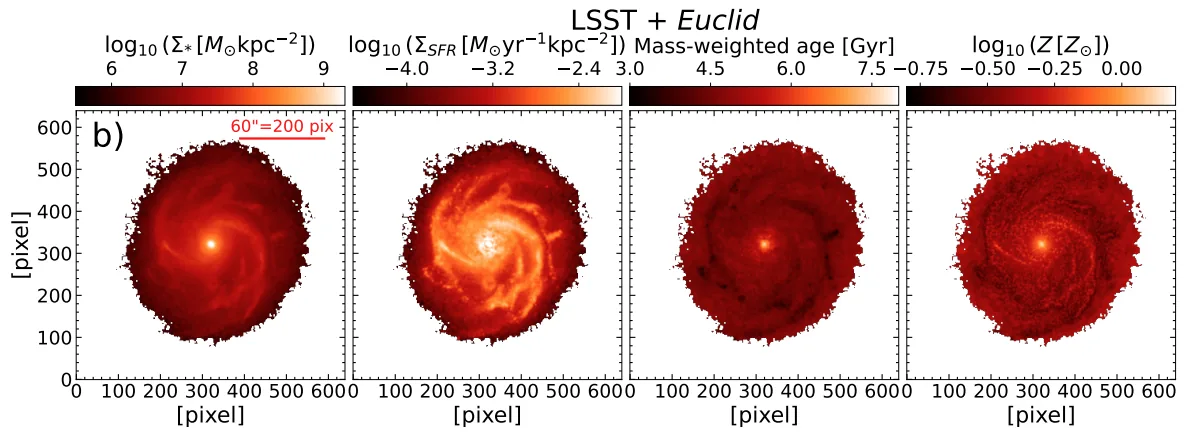
Within the Euclid Consortium, I led a proof-of-concept study using TNG50-based synthetic Euclid + LSST images to test how well spatially resolved SED fitting recovers the stellar populations of local galaxies (Euclid Collaboration: Abdurro’uf et al. 2025). A follow-up study examined how nonparametric star-formation histories affect resolved property estimation (Nersesian, Abdurro’uf et al. 2026). I am also part of the TNG50-SKIRT Atlas team, which produces radiative-transfer post-processed synthetic galaxies (Baes et al. 2024).
// what’s next
- A multi-simulation library: forward-model TNG, EAGLE+FLARES, SIMBA, and THESAN, which span kinetic, thermal, and jet AGN feedback, so inference biases can be measured across physics families.
- GalSyn DR2: a public benchmark of synthetic HST, JWST, Euclid, Rubin, and Roman observations with ground-truth maps, SFHs, and quenching-mechanism labels.
- Constraining feedback physics: forward-model the CAMELS suites to run SBI over supernova and AGN feedback parameters using resolved summary statistics.
- Differentiable dust: a JAX-accelerated, differentiable dust-attenuation module that constrains attenuation curves at high redshift jointly with stellar populations.